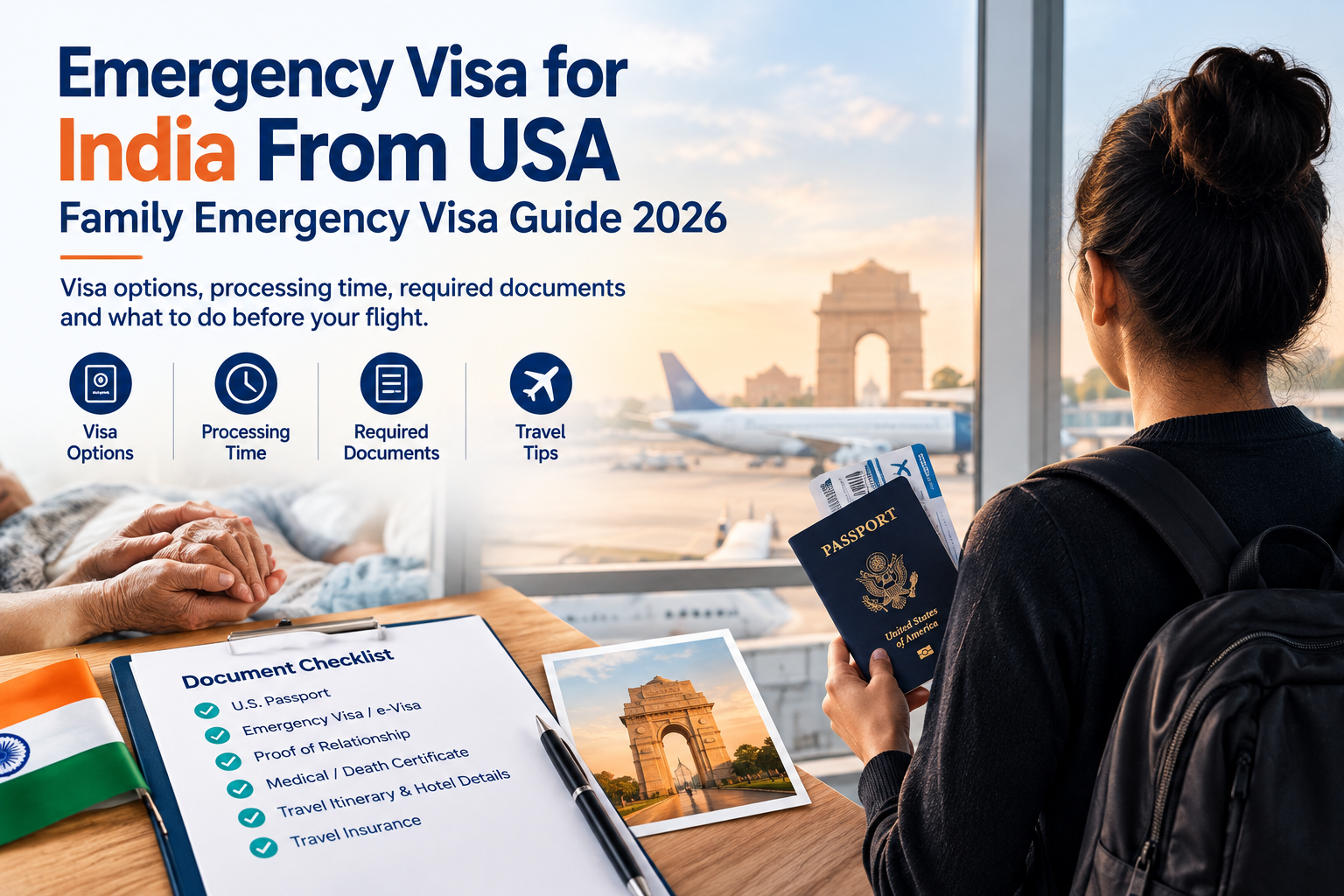
Visiting India for a Family Emergency From the USA? Visa Options, Processing & What to Know
A family emergency can change travel plans in a matter of hours.
If a parent, spouse, sibling, or another close family member in India becomes seriously ill, is hospitalized, or passes away, getting on the next available flight may suddenly become the most important thing in your life.
For people living in the United States, however, there is an important question to answer before heading to the airport:
Can you travel to India immediately, or do you need an Indian visa first?
The answer depends on your citizenship, your Indian-origin status, whether you already have an OCI card, the purpose of your trip, and the type of Indian travel authorization you currently hold.
India does have an Emergency Visa service for certain U.S. passport holders of Indian origin and their eligible family members who need to travel because of a genuine family emergency, such as a critical illness or death. However, an emergency visa is not simply a faster version of every Indian visa, and applicants generally need to provide documentary evidence of the emergency.
This guide explains what U.S.-based travelers should know before making emergency travel arrangements to India.
What Is an Emergency Visa for India?
An Emergency Entry Visa is a special visa service intended for qualifying travelers who need to travel to India because of a genuine family emergency.
Indian consular authorities in the United States describe qualifying circumstances as situations such as:
-
Death of a family member in India
-
Critical illness of a family member
-
Serious hospitalization
-
Certain other genuine family emergencies, depending on the consular authority's assessment
The Emergency Visa service is specifically available to U.S. passport holders of Indian origin and their family members in qualifying circumstances.
Importantly, applicants must provide documentary evidence supporting the emergency. An emergency service fee may also apply.
This means that simply saying that your trip is urgent does not automatically qualify you for emergency processing.
Your situation and supporting documents will be reviewed by the appropriate Indian authorities.
Who Can Apply for an Emergency Indian Visa From the USA?
One of the first things to determine is whether you fall within the eligible category.
Emergency visa services are intended for U.S. passport holders of Indian origin and their family members who need to travel to India because of a genuine family emergency.
For example, you may be dealing with a situation where:
-
Your mother or father has been hospitalized in India.
-
A close family member is critically ill.
-
A family member has passed away.
-
You need to travel urgently for a serious family situation.
The exact procedure can depend on where you live because Indian consular services in the United States are divided into different jurisdictions.
For example, emergency visa information is published by the Consulates General of India in New York, Chicago and Houston for applicants within their respective jurisdictions.
Do not assume that the procedure is identical everywhere in the United States.
Before submitting an emergency application, check which Indian consular jurisdiction covers your U.S. residence.
What Documents May Be Required?
When time is limited, document preparation becomes extremely important.
For an emergency visa application, you should be prepared to provide evidence of both your identity and the emergency.
Your documents may include:
1. Valid U.S. Passport
Your U.S. passport is the primary travel document if you are traveling as a U.S. citizen.
Check that:
-
Your passport is valid.
-
Your name is correct.
-
Your passport is not damaged.
-
The passport information matches your application.
If you recently became a U.S. citizen after previously holding an Indian passport, make sure you understand your current Indian citizenship and visa status before traveling.
2. Proof of the Family Emergency
This is one of the most important parts of an emergency visa application.
Depending on the situation, supporting evidence could include documentation such as:
-
Hospital records
-
Doctor's letter
-
Medical certificate
-
Hospital admission documentation
-
Death certificate
-
Letter from a hospital
-
Other official documentation establishing the emergency
The purpose of these documents is to demonstrate that the situation is genuine and requires urgent travel.
A vague statement or an informal message from a relative may not be enough.
If possible, obtain documentation directly from the hospital, doctor, or relevant authority in India.
3. Proof of Your Relationship
You may also need documents showing your relationship with the person involved in the emergency.
Depending on the relationship, this could include:
-
Birth certificate
-
Marriage certificate
-
Family records
-
Other government-issued documentation
For example, if your father is hospitalized in India, you may need documentation establishing that he is your father.
Make sure names are consistent across documents wherever possible.
4. Passport-Size Photograph and Application Documents
Visa applications generally require photographs and an application form.
Make sure the photograph meets the applicable requirements rather than uploading a random selfie or an incorrectly sized image.
An error in a basic application field can create unnecessary delays when you are already dealing with an urgent situation.
Review:
-
Full name
-
Date of birth
-
Passport number
-
Citizenship
-
Address in the USA
-
Indian address
-
Contact information
-
Emergency details
-
Travel purpose
before submitting the application.
Can You Get an Indian e-Visa Instead?
This is an important question because many U.S. citizens are eligible to apply for India's e-Visa.
U.S. citizens are among the nationalities eligible for India's e-Visa program, subject to the applicable requirements and category.
The Government of India's e-Visa system currently includes categories such as:
-
e-Tourist Visa
-
e-Business Visa
-
e-Medical Visa
-
e-Medical Attendant Visa
-
e-Conference Visa
-
Other eligible e-Visa categories
For someone traveling because a family member is seriously ill, however, you should not automatically assume that an e-Tourist Visa is the correct emergency solution.
The purpose of travel matters.
If you qualify for an emergency visa service because of a genuine family emergency, follow the emergency visa procedure applicable to your consular jurisdiction.
Also remember an important point:
India's official e-Visa system does not provide an “emergency fee” that guarantees an express e-Visa.
Be cautious of websites or individuals claiming that paying an additional emergency fee guarantees immediate approval of an Indian e-Visa.
Is There a Guaranteed Emergency Visa Processing Time?
This is perhaps the most important thing to understand before booking a flight.
There is no universal guaranteed processing time that applies to every emergency visa application in the United States.
Emergency applications are handled according to the applicable consular procedures, and the authorities may request additional documents.
Even when a situation is genuine, the application still has to be reviewed.
The Consulate General of India in Houston specifically advises applicants that an emergency visa is subject to submission of complete documentation and that additional documents may be requested in certain cases.
This is why you should not assume that submitting an application automatically means you can board the next flight.
Should You Buy Your Flight Before Getting the Visa?
Ideally, no.
When someone receives terrible news from India, the natural reaction is to immediately search for the fastest flight.
But visa and immigration requirements should be checked before finalizing non-refundable travel arrangements.
Indian consular guidance advises emergency visa applicants not to finalize travel arrangements before the visa is issued.
Of course, genuine emergencies can make this difficult.
If you are considering purchasing a ticket because of an immediate family emergency, first determine:
-
Whether you already have valid Indian travel authorization.
-
Whether your OCI is valid, if you have one.
-
Whether you qualify for emergency visa processing.
-
Which consular jurisdiction applies to you.
-
What documents are required.
-
How the application must be submitted.
This can prevent a stressful situation from becoming even more complicated.
What If You Already Have an OCI Card?
If you are a U.S. citizen of Indian origin and already hold a valid OCI card, your situation may be significantly different.
OCI provides eligible foreign citizens of Indian origin with immigration benefits for travel to India.
If your OCI documentation is valid and you are traveling under the conditions permitted by your OCI status, you may not need to apply for an emergency tourist visa simply because the trip is urgent.
However, you should still verify your current passport and OCI documentation before traveling.
Check:
-
Your U.S. passport
-
OCI card/e-OCI documentation
-
Name consistency
-
Passport details
-
Any applicable OCI update requirements
If your circumstances have changed since receiving OCI, check whether an update is required.
What If You Recently Became a U.S. Citizen?
This is another situation where travelers should be particularly careful.
A person who previously held Indian citizenship and subsequently acquired U.S. citizenship generally ceases to be an Indian citizen and must surrender the Indian passport.
Therefore, if you recently became a U.S. citizen, do not simply take your old Indian passport to the airport and assume you can use it for your emergency trip.
You should determine whether you have:
-
Completed Indian passport surrender/renunciation formalities where applicable
-
Received your Surrender Certificate
-
Obtained OCI
-
Obtained an appropriate Indian visa if you do not have OCI
If you have recently naturalized and a family emergency occurs before your OCI process is complete, getting the correct travel authorization becomes especially important.
What If the Emergency Happens on a Weekend or Holiday?
Family emergencies do not follow office hours.
This is why you should check the emergency visa procedure for the Indian consulate covering your state.
Some Indian consular jurisdictions provide emergency arrangements outside normal weekday processing for qualifying cases.
For example, published guidance from Indian consular authorities in the United States has provided emergency visa contact procedures for weekends and holidays.
However, the exact process, hours, submission method and contact information can change.
Do not rely on an old phone number found in a random blog or social media post.
Always verify the current emergency instructions through the appropriate Indian consulate or its designated visa service provider.
Which Indian Consulate Should You Contact?
The United States is divided among different Indian consular jurisdictions.
Your residence determines which consular authority handles your application.
Major Indian consular jurisdictions include:
-
New York
-
Chicago
-
Houston
-
San Francisco
-
Atlanta
-
Washington, D.C.
Not every emergency visa procedure is identical.
Before applying, identify the consular jurisdiction that covers your current U.S. address.
For applicants who fall under a consulate's emergency visa process, the application may need to be submitted through the designated visa application service or according to the specific emergency instructions issued by that consulate.
Emergency Visa vs. Regular Visa vs. e-Visa
Understanding the difference can save valuable time.
| Option | Best suited for | Emergency processing? |
|---|---|---|
| Emergency Entry Visa | Genuine qualifying family emergency | Special emergency procedure |
| Regular Indian Visa | Normal travel where e-Visa is not appropriate | Normal processing |
| e-Tourist Visa | Eligible tourism/family visits | Not an emergency guarantee |
| OCI | Eligible foreign citizens of Indian origin | Not a visa application for each trip |
| e-Medical Visa | Eligible medical treatment in India | Separate category |
The right option depends on your circumstances.
For example, someone traveling to attend a family wedding generally does not have the same reason for emergency processing as someone whose parent has been admitted to a hospital.
Can a Family Member in India Apply for You?
Your relatives in India can help you gather supporting documentation, but do not assume that they can complete every part of the visa process on your behalf.
They can potentially provide:
-
Hospital documents
-
Medical letters
-
Death certificate
-
Proof of relationship
-
Indian address
-
Contact details
-
Other supporting evidence
Ask your family member or hospital to send clear scans or photographs of relevant documents.
Poor-quality images can create unnecessary problems when you need the information quickly.
What Should You Do Immediately After Receiving the Emergency Call?
If you are in the United States and receive news that a close family member in India is critically ill or has passed away, use this order of steps:
Step 1: Confirm the situation
Ask your family for the hospital or official documentation confirming the emergency.
Step 2: Check your passport
Make sure your U.S. passport is valid and accessible.
Step 3: Check your Indian travel status
Determine whether you have:
-
OCI
-
e-OCI
-
Existing Indian visa
-
No current Indian travel authorization
Step 4: Identify your consular jurisdiction
Find the Indian consulate responsible for your U.S. residence.
Step 5: Collect supporting documents
Ask your family for hospital or official documentation and proof of relationship.
Step 6: Check the current emergency procedure
Follow the current instructions from the appropriate Indian consulate and designated visa service.
Step 7: Submit the application correctly
Double-check every field and upload the requested documents.
Step 8: Wait for confirmation before assuming you can travel
Do not treat submission of an application as approval.
Be Careful With “Guaranteed Emergency Visa” Claims
When people are desperate to reach a sick or dying family member, they are understandably willing to pay for help.
Unfortunately, that also creates an opportunity for misleading services.
Be cautious if someone claims:
-
“Guaranteed Indian visa in one hour”
-
“Pay extra and approval is guaranteed”
-
“No documents required”
-
“Emergency e-Visa guaranteed”
-
“You don't need to prove the emergency”
Indian authorities specifically state that the e-Visa system does not provide an emergency fee that guarantees an express e-Visa.
For emergency visa services, eligibility and approval remain subject to the applicable authorities and documentation.
What About an Emergency Travel Document?
An Emergency Certificate (EC) is different from an Emergency Visa.
An Emergency Certificate is generally a one-way travel document used in specific situations involving Indian nationals who need to return to India and do not have a valid Indian passport, such as certain cases involving a lost, stolen, damaged, expired or otherwise unavailable Indian passport.
It is not simply an alternative emergency visa for a U.S. citizen who wants to visit India.
If you are a U.S. citizen traveling to India for a family emergency, determine whether you need an emergency visa, regular visa, e-Visa or another travel document based on your actual citizenship and circumstances.
Final Checklist for Emergency Travel to India From the USA
Before heading to the airport, check:
Passport
-
Valid U.S. passport
-
Passport information matches your application
Indian travel authorization
-
Valid OCI/e-OCI, or
-
Appropriate Indian visa/e-Visa
Emergency evidence
-
Hospital letter
-
Medical records
-
Death certificate or other applicable proof
Relationship evidence
-
Birth certificate
-
Marriage certificate
-
Other relevant family documentation
Application
-
Correct application
-
Correct photograph
-
Correct passport details
-
Supporting documents uploaded
Consular jurisdiction
-
Correct Indian consulate for your U.S. residence
-
Current emergency contact instructions
Flight
-
Confirm travel only after understanding the applicable visa requirements
-
Check airline documentation requirements
Final Thoughts
A family emergency is stressful enough without discovering at the last minute that your Indian travel documents are not in order.
For U.S. citizens of Indian origin, India provides an emergency visa service for qualifying genuine family emergencies, including situations involving serious illness or death. But emergency processing is not an automatic visa approval, and applicants need to provide appropriate supporting evidence.
If you already have OCI, your situation may be different. If you recently became a U.S. citizen, you may need to consider your former Indian citizenship, passport surrender, OCI or visa status before traveling.
The most important thing is to identify the correct travel authorization before you book or board your flight.
If you are facing an urgent family situation and need help understanding which Indian visa option may apply to your circumstances, IndianVisaOnline.com can help you review the applicable visa route and prepare your application.
When every hour matters, having the right documents ready can make the process much easier.