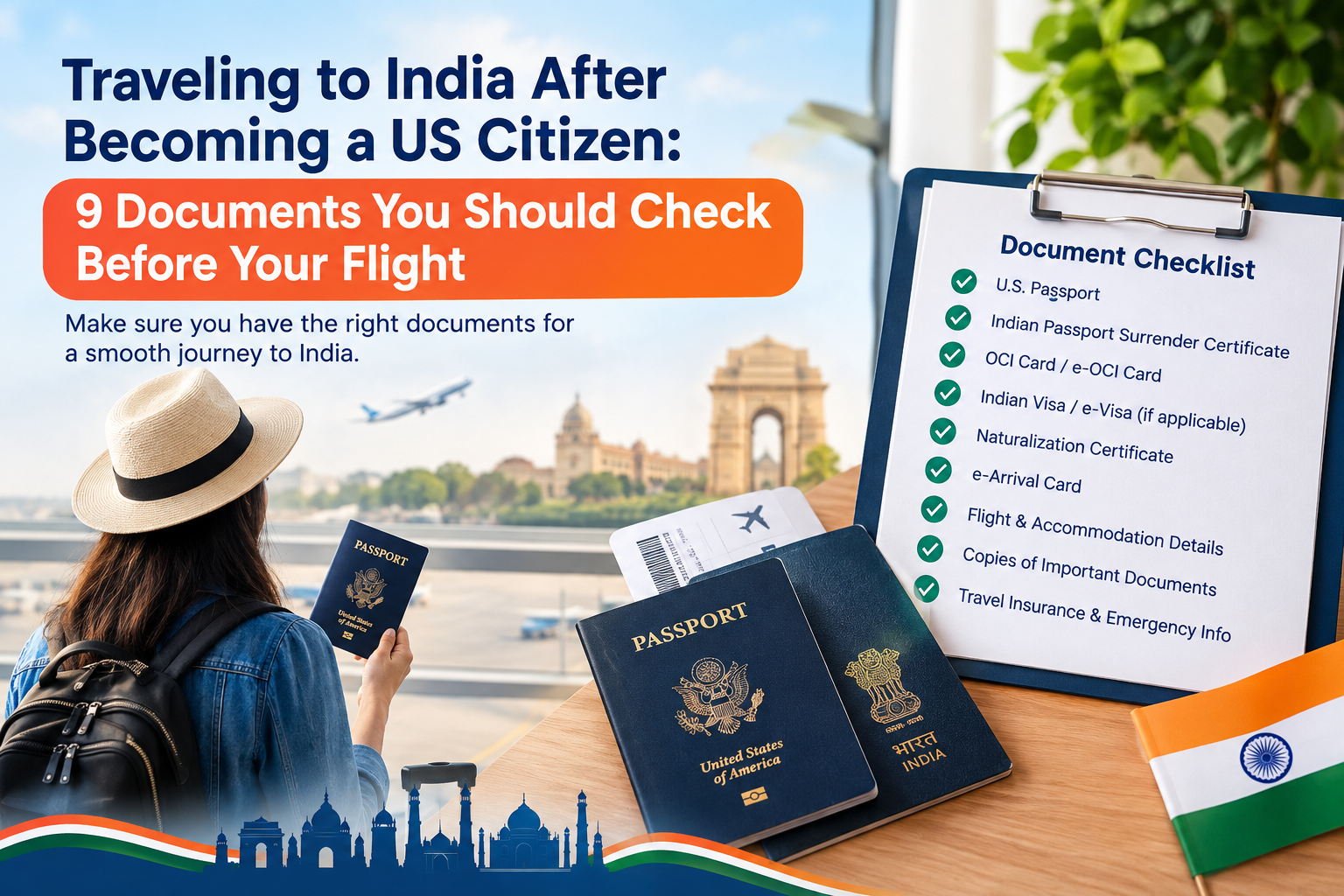
Traveling to India After Becoming a US Citizen: 9 Documents You Should Check Before Your Flight
Becoming a U.S. citizen is a major milestone, especially for people who were born in India or previously held Indian citizenship. But if you are planning your first trip to India after becoming a U.S. citizen, there is one important thing to understand: your travel documents may be different from what you used before becoming a U.S. citizen.
Many Indian Americans assume they can simply book a flight using their U.S. passport and travel to India as they did before. In reality, you may need to check your U.S. passport, Indian passport surrender documentation, OCI status or Indian visa, and other travel documents before leaving the United States.
India does not permit dual citizenship. A person who voluntarily acquires foreign citizenship generally ceases to be an Indian citizen and must surrender their Indian passport.
If you recently became a U.S. citizen and are planning to visit India for a family visit, wedding, vacation, business trip, or other purpose, use this checklist before you head to the airport.
1. Your Valid U.S. Passport
Your U.S. passport is the most important document you should check before traveling to India.
Once you become a U.S. citizen, you should travel internationally using your U.S. passport. Before booking your trip, check:
-
Your full name
-
Date of birth
-
Passport number
-
Passport expiration date
-
Any damage to the passport
-
Whether you have enough blank pages for travel documentation
The U.S. Department of State recommends checking passport validity well before international travel. Some countries require passports to have at least six months of remaining validity, and airlines may also apply their own document checks.
For an Indian visa or e-Visa, the passport used for the application is particularly important. Indian government guidance states that travelers should have a passport with at least six months of validity and at least two blank pages for immigration processing.
Tip: Do not wait until the week before your flight to discover that your U.S. passport is about to expire.
2. Your Indian Passport Surrender Certificate
If you became a U.S. citizen after previously being an Indian citizen, check whether you have completed the required Indian passport surrender process.
India does not recognize dual citizenship. According to the Consulate General of India, a person who held Indian nationality and subsequently voluntarily acquires the nationality or passport of another country ceases to be an Indian national and is required to surrender the Indian passport.
Your Surrender Certificate is therefore an important document to keep with your records.
It can be especially useful when establishing your previous Indian citizenship or when applying for OCI.
If you still have your old Indian passport at home, do not assume that it remains a valid travel document simply because it has not expired. Becoming a U.S. citizen changes your citizenship status.
Keep copies of:
-
Your old Indian passport
-
Surrender Certificate
-
Relevant citizenship documentation
These documents can also help if you later need to prove your Indian-origin status.
3. Your OCI Card or e-OCI Card
For many Indian Americans, the OCI card is the preferred long-term solution for visiting India after becoming a foreign citizen.
OCI stands for Overseas Citizen of India. It is not Indian citizenship. Instead, it provides eligible foreign citizens of Indian origin with immigration benefits, including a lifelong multiple-entry visa for visiting India for eligible purposes.
There is also an important 2026 update travelers should know.
India has introduced the e-OCI card, which provides a digital version of the OCI card. From July 8, 2026, new OCI applicants are being issued digital OCI cards, while existing physical OCI cards continue to remain valid.
If you already have an OCI card, check:
-
Your OCI details
-
Your current U.S. passport details
-
Your name and date of birth
-
Whether your passport information needs to be updated
-
Your digital e-OCI availability
The official OCI portal states that the e-OCI is free to download and provides a digital representation of the OCI card.
Important:
An OCI card is not the same thing as a U.S. passport. You should carry your valid foreign passport along with your OCI documentation when traveling to India.
4. Your Indian Visa or e-Visa — If You Do Not Have OCI
Not every former Indian citizen automatically has an OCI card.
If you are a U.S. citizen of Indian origin and do not have OCI, you may need an appropriate Indian visa before traveling.
For eligible U.S. citizens traveling for tourism, an Indian e-Tourist Visa may be an option. U.S. nationals are among the nationalities eligible for India's e-Visa program.
Before applying, determine which document actually applies to your situation:
U.S. citizen + valid OCI → travel using your U.S. passport and OCI documentation.
U.S. citizen without OCI → determine the appropriate Indian visa or e-Visa based on the purpose of travel.
Do not apply for an Indian visa using an old Indian passport that is no longer valid for your current citizenship status.
If you are unsure whether you should use an OCI or visa, getting your documents reviewed before submitting an application can help prevent avoidable errors.
5. Your Naturalization Certificate
If you recently became a U.S. citizen through naturalization, keep your Certificate of Naturalization in your important-document file.
You generally do not need to carry the original naturalization certificate with you simply to enter India when you are traveling with your valid U.S. passport and appropriate Indian travel authorization.
However, it can be an important supporting document for citizenship and OCI-related records.
The OCI application documentation specifically includes proof of present citizenship, such as a valid current passport and a citizenship registration or naturalization certificate.
It is therefore sensible to keep:
-
Original Naturalization Certificate securely stored
-
A digital copy
-
A backup copy stored separately
Do not pack the original in checked baggage.
6. Your India e-Arrival Card
A document many travelers may overlook is India's e-Arrival Card.
The Government of India's visa portal states that foreign nationals and OCI cardholders can complete the e-Arrival Card online within 72 hours before arrival in India. It is an arrival-information form, not a visa.
The form asks for information such as:
-
Passport number
-
Nationality
-
Date of arrival
-
Countries visited recently
-
Address in India
-
Email address
-
Contact information
-
Emergency contact information
The e-Arrival Card is free through the official government system.
This is particularly important for U.S. citizens returning to India because having a valid visa or OCI does not eliminate the need to complete the required arrival information.
Do not confuse the e-Arrival Card with an e-Visa.
They serve completely different purposes.
An e-Visa provides travel authorization.
An e-Arrival Card provides arrival information to Indian immigration authorities.
7. Your Flight and Accommodation Details
Although your airline ticket is not a substitute for a visa or OCI, keeping your travel details organized can make your journey considerably easier.
Keep digital and, preferably, printed copies of:
-
Confirmed flight itinerary
-
Return or onward flight details
-
Hotel reservation
-
Address where you will stay in India
-
Contact information of family members or hosts
This information can also be useful when completing India's e-Arrival Card because the form asks for an address in India.
If you are staying with your parents or relatives rather than in a hotel, make sure you know their complete address, including the city, state and PIN code.
This sounds simple, but travelers frequently find themselves trying to locate an Indian address from an old WhatsApp message while standing at an airport.
Prepare it before you leave.
8. Copies of Your Important Travel Documents
Do not rely exclusively on physical documents.
The U.S. Department of State recommends making copies of important travel documents and keeping copies separately from the originals. It also recommends keeping digital photographs of travel documents.
For a first trip to India after becoming a U.S. citizen, consider keeping secure copies of:
-
U.S. passport
-
OCI card/e-OCI
-
Indian visa/e-Visa, if applicable
-
Surrender Certificate
-
Old Indian passport
-
Naturalization Certificate
-
Flight itinerary
-
Travel insurance
-
Important contact information
Store digital copies securely on your phone and in a secure cloud account.
You can also leave a copy with a trusted family member in the United States.
However, remember that a photocopy or digital copy does not replace the original passport or required travel authorization.
9. Travel Insurance and Emergency Information
Travel insurance is not the same as a visa requirement, but it is an important document to consider before an international trip.
If you are traveling to India after many years away, you may be visiting multiple cities, spending time with family, or planning domestic travel after arriving.
Keep your insurance information accessible, including:
-
Policy number
-
Insurance provider
-
Emergency assistance phone number
-
Coverage information
-
Medical assistance details
Also keep emergency contact information for someone in the United States and someone in India.
For longer trips, business travel, or travel involving medical treatment, additional documentation may be appropriate depending on your circumstances.
A Special Checklist for Former Indian Citizens
If you were an Indian citizen before becoming a U.S. citizen, your checklist is slightly different from that of an American who has never had an Indian connection.
Before your first trip, ask yourself:
Have I surrendered my Indian passport?
If yes, keep the Surrender Certificate safely stored.
Do I have an OCI card?
If yes, check that your current passport information is properly reflected and keep your OCI/e-OCI information available.
If I don't have OCI, do I have the correct Indian visa?
Do not assume your previous Indian passport gives you the right to enter India.
Am I traveling on my current U.S. passport?
Make sure the passport information matches your travel authorization.
Have I completed my e-Arrival Card?
Foreign nationals and OCI cardholders are required to submit the applicable arrival information within the specified window before arrival.
What If You Recently Became a U.S. Citizen and Have Not Yet Gotten OCI?
This is one of the most important situations to address before booking a non-refundable flight.
If you previously held Indian citizenship but have now become a U.S. citizen, do not assume that your old Indian passport can simply be used for your next trip.
Your Indian citizenship status and travel documentation need to be handled correctly.
Depending on your circumstances, you may need to complete the Indian passport surrender process and then determine whether you qualify for OCI or need an Indian visa for your planned trip.
The OCI process itself requires documentation relating to your current foreign citizenship and, where applicable, your surrendered Indian passport.
If your trip is approaching and you are unsure which route applies to you, check your eligibility and document requirements before purchasing a non-refundable ticket.
U.S. Citizen vs. OCI Holder: What Should You Carry?
Here is a simple way to think about your travel documents:
| Your situation | Main travel documents |
|---|---|
| U.S. citizen with OCI | Valid U.S. passport + OCI/e-OCI |
| U.S. citizen without OCI | Valid U.S. passport + appropriate Indian visa/e-Visa |
| Recently naturalized U.S. citizen | U.S. passport + appropriate Indian travel authorization + relevant Indian citizenship/surrender records |
| Former Indian citizen applying for OCI | U.S. passport + OCI application/supporting documents until OCI is issued |
| U.S. citizen traveling for tourism without OCI | U.S. passport + eligible Indian tourist visa/e-Visa |
The exact requirements can vary according to your nationality history, purpose of travel, passport and immigration status.
Common Mistakes to Avoid Before Flying to India
Mistake 1: Traveling with an old Indian passport
Becoming a U.S. citizen changes your Indian citizenship status. Do not assume an old Indian passport can be used as your current travel document.
Mistake 2: Applying for a visa with incorrect passport information
Your Indian visa or e-Visa should correspond to the passport you will use for travel.
Mistake 3: Forgetting the OCI/e-OCI documentation
Having a U.S. passport alone does not automatically give a former Indian citizen OCI privileges.
Mistake 4: Leaving the e-Arrival Card until the airport
Complete it within the required period before arriving in India.
Mistake 5: Carrying only digital copies
Keep the required original travel documents with you.
Mistake 6: Waiting until the last minute
Visa, OCI and passport-related issues are much easier to resolve when you have time before your flight.
Final Pre-Flight Checklist
Before leaving for the airport, check these nine items:
1. U.S. passport — Valid and in good condition.
2. Indian Passport Surrender Certificate — If you previously held Indian citizenship and completed surrender.
3. OCI/e-OCI — If you are an OCI cardholder.
4. Indian visa/e-Visa — If you are traveling without OCI and your trip requires a visa.
5. Naturalization Certificate — Keep securely stored and carry a copy if appropriate for your circumstances.
6. e-Arrival Card — Complete within 72 hours before arrival as applicable.
7. Flight and India address details — Keep your itinerary and destination address accessible.
8. Document backups — Secure digital and physical copies of critical documents.
9. Travel insurance and emergency contacts — Keep policy and emergency information easily accessible.
Planning Your First India Trip as a U.S. Citizen?
The biggest mistake is assuming that the documents you used before becoming a U.S. citizen are still the right documents today.
Your first step should be determining whether you will travel to India using OCI or an Indian visa.
If you are a U.S. citizen of Indian origin, recently naturalized, or planning your first India trip after surrendering your Indian passport, getting your documentation organized early can save you unnecessary stress before your flight.
If you need assistance understanding the Indian visa application process or preparing your application, IndianVisaOnline.com provides visa application assistance for travelers applying from the United States.
Check your eligibility, prepare your documents carefully, and make sure your travel authorization matches the passport you will actually use to enter India.
Plan your India trip with the right documents before you fly.